The Complete Head Gasket Diagnosis Guide
Free Guide to Diagnosing Head Gasket Failure Without Guesswork
Before you spend hundreds—or even thousands—on engine repairs, learn how to identify the real cause of your cooling system problems.
Introduction
Many symptoms of a blown head gasket are also caused by far less expensive problems such as a faulty thermostat, radiator cap, water pump or coolant leak.
This guide explains how to identify the warning signs, rule out common causes and confirm whether combustion gases are entering your cooling system.
By following these simple checks, you'll avoid unnecessary repairs and make informed decisions.
Common Symptoms of a Failing Head Gasket
You may have a head gasket problem if you notice one or more of the following:
✓ Engine overheating
✓ Coolant level constantly dropping
✓ White smoke from the exhaust
✓ Coolant bubbling in the expansion tank
✓ Cooling system becoming pressurised shortly after starting
✓ Heater blowing cold air intermittently
✓ Poor engine performance
✓ Sweet smell from the exhaust
✓ Mayonnaise-like sludge under the oil filler cap (not always conclusive)
Remember: One symptom alone does not necessarily mean the head gasket has failed.
Common Problems That Mimic Head Gasket Failure
Before assuming the worst, check these items:
Low coolant level
External coolant leaks
Faulty radiator cap
Sticking thermostat
Blocked radiator
Cooling fan failure
Water pump failure
Air trapped in the cooling system
These faults are much cheaper to repair and often produce similar symptoms.
Step-by-Step Diagnostic Process
Step 1 – Check Coolant Level
Only check when the engine is cold.
If coolant is low, inspect for visible leaks before topping up.
Step 2 – Look for External Leaks
Inspect:
Radiator
Hoses
Heater hoses
Water pump
Expansion tank
Thermostat housing
Repair any leaks before continuing diagnosis.
Step 3 – Observe Exhaust Smoke
A small amount of white vapour on a cold morning is perfectly normal.
Persistent thick white smoke after the engine has warmed up may indicate coolant entering the combustion chamber.
Step 4 – Watch for Coolant Bubbling
With the engine at operating temperature, excessive bubbling in the expansion tank may indicate combustion gases entering the cooling system.
However, trapped air can also cause bubbling, so further testing is essential.
Step 5 – Feel Cooling System Pressure
If the upper radiator hose becomes rock hard only a minute or two after a cold start, combustion gases may be rapidly pressurising the cooling system.
The Most Reliable Test
Symptoms alone cannot confirm a blown head gasket.
The quickest and most reliable non-invasive method is a combustion leak (block) test.
A combustion leak tester detects combustion gases (CO₂) escaping into the cooling system before major engine damage occurs.
Unlike visual inspections, it provides clear chemical confirmation.
How a Combustion Leak Tester Works
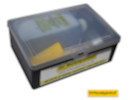
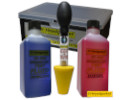
The tester draws gases from the radiator or expansion tank through a special test fluid.
If combustion gases are present:
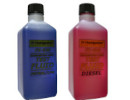
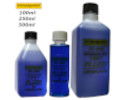
Blue Test Fluid → Changes to Yellow (or RED) depending on formulation. The Red fluid is modern development, more sensitive with much better colour transition.
Red fluid is more universal, works great with Petrol/Diesel/LPG. Blue fluid is for Petrol, we don't recommend using it on Diesel engines due to poor colour transition and lower sensitivity.
No colour change generally indicates that combustion gases are not present at the time of testing.
Always follow the instructions supplied with your tester and ensure the engine is at operating temperature for the most accurate results.
Why Early Diagnosis Matters
Driving with a leaking head gasket can lead to:
Warped cylinder head
Engine overheating
Catalytic converter damage
Coolant contamination
Complete engine failure
Early testing can save thousands in repair costs.
Frequently Asked Questions
Can a head gasket fail without white smoke?
Yes. Many vehicles show no visible smoke during the early stages.
Can oil look normal?
Yes. Oil contamination often appears only after the leak becomes severe.
Will a compression test always detect a blown head gasket?
No. Small combustion leaks can sometimes pass a compression test but still be detected using a combustion leak tester.
Can I test the vehicle myself?
Yes. A combustion leak tester is designed for DIY enthusiasts as well as professional mechanics.
Why Thousands of Mechanics Use Combustion Leak Testers
Professional technicians rely on combustion leak testers because they provide:
Fast results
No engine dismantling
Simple operation
Low testing cost
Reliable confirmation of combustion gas leaks
Next Step
If your vehicle shows several of the symptoms described in this guide, the next step is to perform a combustion leak test.
A quality combustion leak tester with fresh test fluid allows you to confirm the diagnosis in just a few minutes, helping you avoid unnecessary repairs and giving you confidence before making expensive decisions.

About Us
We specialise in R&D and manufacturing high-quality combustion leak testers and premium test fluid trusted by mechanics, workshops and vehicle owners. Our products are designed to deliver accurate, repeatable results, helping you diagnose cooling system problems quickly and confidently.
Visit our website to learn more, view demonstration videos and find the right tester and refill fluid for your needs.